Paul Etienne Lincoln
21 September - 15 December 2004
pictures 


Guido Costa Projects is proud to announce Sinfonia torinese, the new exhibition of Paul Etienne Lincoln.
Sinfonia torinese is a mesmerizing salutation to the city of Turin, a veiled portrait, derived from a variety of natural, cultural, historical and mythological phenomena. The installation at via Mazzini 24 is presented as a chain of interconnecting objects, which culminate in the creation of a concerto, a concerto of the rarest nature.
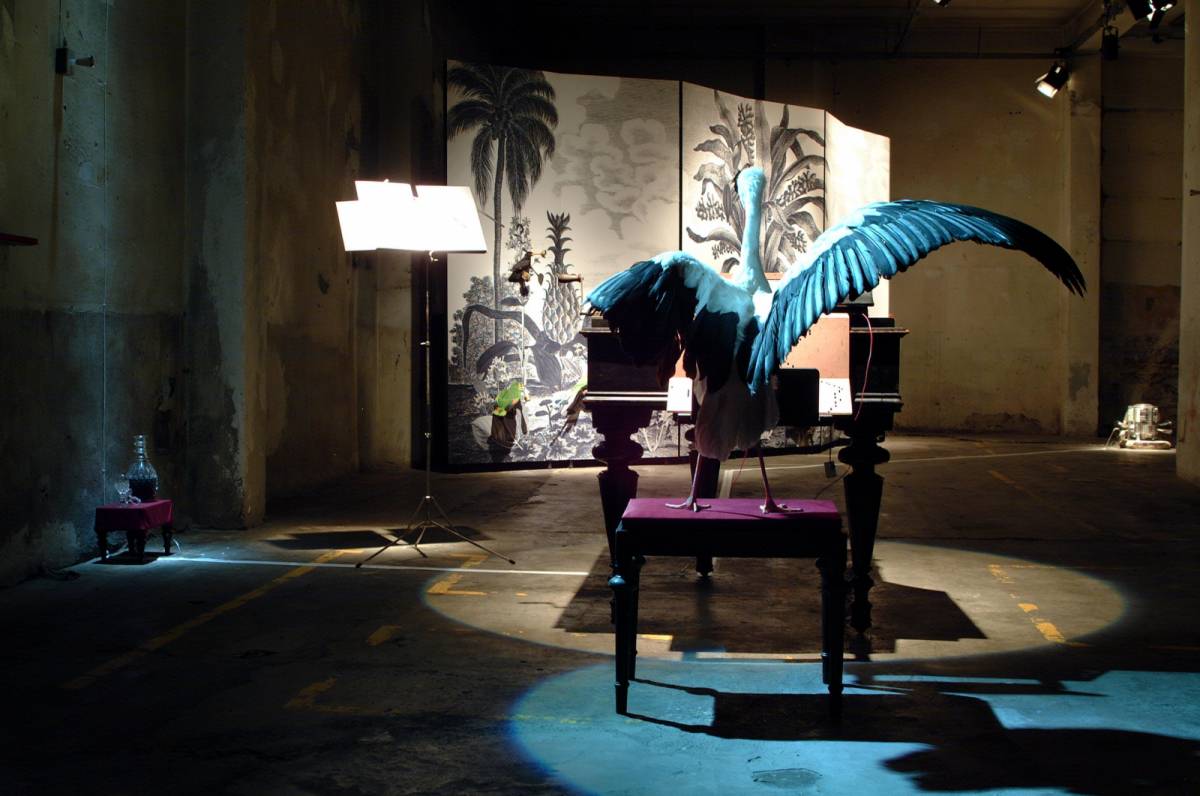
On entering the installation the viewer immediately encounters a large limestone plynth made up of lythographic memorabilia relating to the culinary heritage of Turin, with fifteen bottles of Carpano’s Punt e Mes, positioned in a triangular grid formation. A glass still and a fifteen-channel peristaltic pump are placed directly in front of this battery of bottles. Transparent tubes lead from the bottles, via the pump, to a large folding seven-panel screen whose front surface is entirely covered by an etching of a picturesque winter garden. Fourteen of the tubes snake around to the crimson velvet covered rear of the screen and are connected to fourteen stuffed song birds which are perched on small branches mounted on the etching on the front of the screen. Each bird has a miniature decoy whistle in its beak, and they all direct their gaze toward a grand piano in the far end of the space. A stuffed white stork with wings spread stands on the far side of the piano. This instrument lacks a keyboard, being a rare automatic jacquard paper scored piano. A small ECG (electrocardiograph) sensor is positioned on the stork’s heart, and a wire connects it to the piano’s soundboard, as if its heartbeat invisibily influences the piano’s tone.
Carpano’s Punt e Mes, the famous eighteenth-century torinese aperitiv, with its bitter aromatic disposition is the ultima cura to this work. Prior to the exhibition of the installation a quantity of Punt e Mes will be broken down into its various constituent parts using chromatography: this process will divulge the individual herbs and plant extracts which form the core of this aperitif. The bottles of Punt e Mes that adorn the stone plynth are filled with the fourteen individual herbal extracts in volumetric proportion to the original aperitif. The fifteen bottles, nestling in the center of the triangular labyrinth contains the complete spirit, awaiting distillation for its alcohol and water content. This central bottle (replaced daily after the residue from the previous day’s distillation is drained from the still), serves as fresh fuel for song; the bird’s individual chirping cease the moment their respective herbs reach their delicate syrinx.
Sinfonia torinese is a performing work: the distillation of the Punt e Mes and the subsequent release of alcohol and water sets the pump and piano in motion. The piano, a seventy-three-note Melodico Grand Piano made by Giovanni Racca is operated by a conductor who crank the piano on observation of pure alcohol being pumped from the still. The grand piano will play a specially produced score based on a segment of music from the film Cabiria (Giovanni Pastrone, Itala Film, Torino, ca. 1914).
Via Mazzini 24 have seven sensors arranged within the exhibition space. These sensors, allegorically related to the five human senses and the two additional avian senses (sensitivity to electromagnetic and ultrasonic waves), activate two banks of seven pumps, one for each of the fourteen bottles containing the constituents of Punt e Mes. The random operation of the pumps, determined by the activity within and around the space, causes the flow of the essences through the tubing from the bottles to the songbirds, in turn causing air within the tubing to flow to the bird’s whistles. Thus passage of visitors and physical events within the building will direct the bird’s performance and the composition of their combined efforts.
The etching on the screen (specially retouched to incorporate an image of each of the constituent plants andherbs), portrays an idealized view of a lush tropical garden. Each of the birds-all migratory but all found in Italy-is mounted beside the image of the plant or herb originally grown in an area to which the birds is indigenous.